
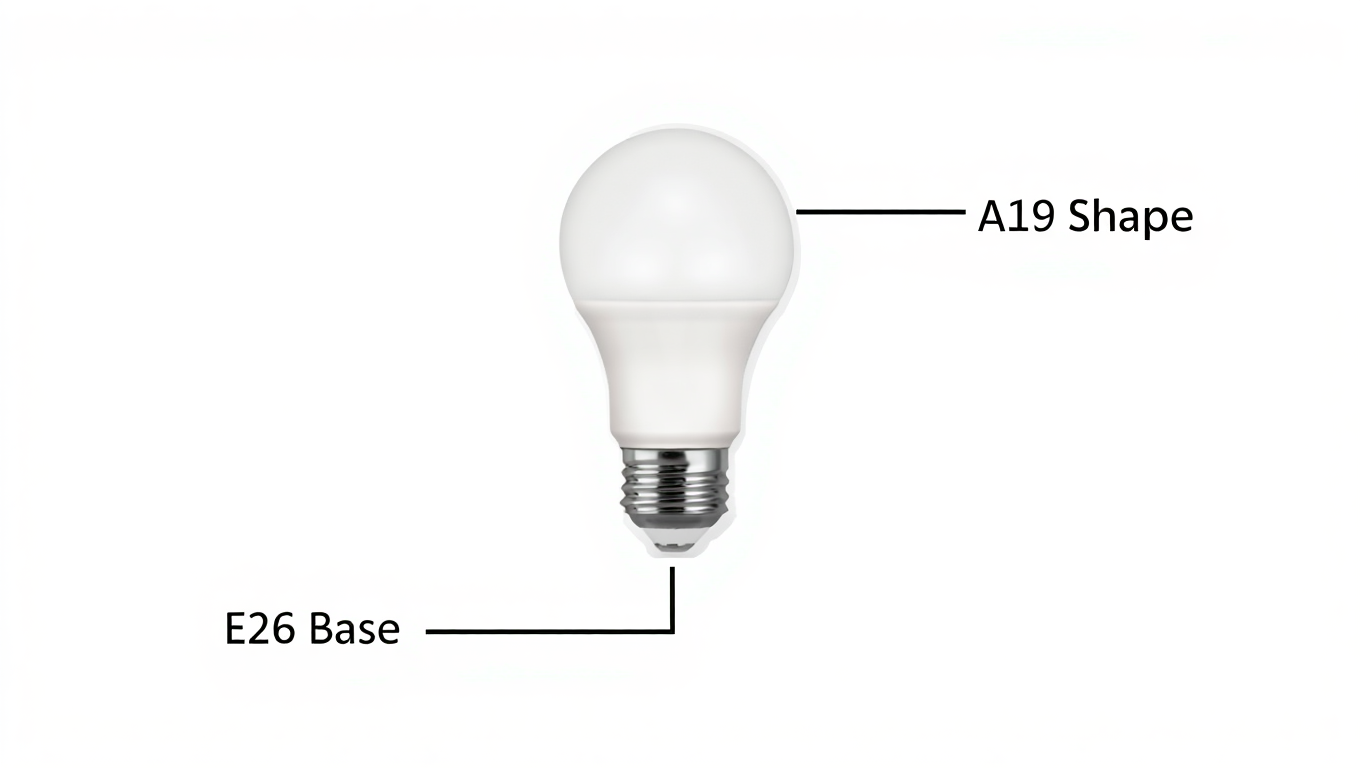
If you’ve ever shopped for light bulbs, you’ve probably noticed the terms “E26” and “A19” printed on packaging and wondered if they mean the same thing. Many buyers assume they’re interchangeable, but that’s only half true. These designations describe two different parts of a bulb—the base and the shape.
Understanding the difference can help you buy the right replacement without wasting money or damaging your fixture. In this guide, we’ll break down the technical details, compatibility factors, and tips for choosing the perfect bulb for your home or workspace.
Understanding the Basics of Light Bulb Codes
Before comparing E26 and A19, it’s important to understand what these codes actually mean. They’re not random model numbers—each one follows a global naming system that helps identify a bulb’s physical characteristics.
What “E26” Really Means?
The “E” in E26 stands for Edison Screw, named after Thomas Edison, who pioneered the screw-base bulb design. The “26” refers to the diameter of the base—26 millimeters. This screw base is the most common in North America and fits most household fixtures such as table lamps, ceiling lights, and garage bulbs.
E26 bulbs typically operate on 120 volts, the standard voltage in the U.S. and Canada. You’ll also find variations like E12 (candelabra), E17 (intermediate), and E39 (mogul) bases for specialized fixtures. For instance, refrigerator bulbs often use E17 bases, while street lamps may use E39. So, when you see E26, think of it as describing how the bulb connects to the socket—not how it looks or performs.
What “A19” Refers To?
“A19” refers to the shape and size of the bulb. The “A” stands for “arbitrary,” meaning the classic pear-shaped bulb most people picture when they think of a light bulb. The “19” equals 19 eighths of an inch in diameter, or about 2.375 inches.
A19 bulbs are the most widely used shape for general lighting. Other shapes like A15 (smaller) or A21 (larger) exist for different applications. The A19’s round design spreads light evenly in all directions, making it ideal for bedrooms, kitchens, and offices. Remember, A19 describes the bulb’s shape and size, not the base—so an A19 bulb can have an E26 base or another type entirely.
E26 vs A19 — Key Differences Explained
Now that you know the codes, let’s clear up the confusion: E26 and A19 describe different aspects of a bulb. One refers to the connection type, the other to the physical shape.
Base Type vs Bulb Shape
Think of the E26 as the “plug” and the A19 as the “body.” E26 specifies the screw-in portion at the bottom of the bulb, while A19 refers to the bulb’s outer glass shape and size. An A19 bulb with an E26 base is the standard household light bulb in North America.
For example, you can have a G25 (globe-shaped) bulb or a BR30 (floodlight) bulb with the same E26 base. The difference is in the bulb’s shape and light distribution, not the connection.
Interchangeability and Compatibility
Most A19 bulbs use E26 bases, which makes them compatible with almost any standard lamp or light fixture. That’s why many people assume they’re the same. However, not every E26 bulb is an A19. You’ll find tube-shaped, reflector-style, and decorative bulbs that also use the E26 base.
Exceptions include smart bulbs or oversized LEDs that might have slightly different dimensions, making them unsuitable for enclosed or small fixtures. Always check the manufacturer’s specifications before buying replacements—especially for recessed lighting or dimmable systems.
International Comparison
In Europe, the equivalent of the E26 base is the E27. The physical size difference is only 1 millimeter, but the voltage rating varies. E26 bulbs are designed for 120V systems, while E27 bulbs run on 220–240V.
Although you can often screw an E27 bulb into an E26 socket, doing so isn’t recommended due to electrical incompatibility. For example, using an E27 bulb in the U.S. might cause flickering, overheating, or early failure. Always match the voltage and certification standards for your region.
Technical Details Car Owners and Homeowners Should Know
Understanding the physical and electrical details of your light bulb ensures you get the best performance and safety. Here’s a breakdown of the main technical aspects to consider.
Dimensions and Fit
An E26 base measures 26 mm across, while an A19 bulb’s overall diameter is about 2.375 inches. Most A19 bulbs with E26 bases fit perfectly in standard sockets, but fixture design matters. Enclosed fixtures, for instance, may not accommodate longer bulbs.
If you’re replacing bulbs in lamps with tight shades or recessed housings, measure the clearance first. Overly large bulbs can trap heat and shorten their lifespan, especially in LED models.
Voltage and Wattage
E26 sockets in the U.S. typically operate on 120V systems. The standard A19 LED bulb consumes between 5W and 12W but delivers brightness equivalent to 40W–100W incandescent bulbs. This efficiency is one of the main reasons homeowners switch to LEDs.
Here’s a quick comparison:
| Bulb Type | Power Usage | Equivalent Brightness | Typical Lifespan |
| Incandescent A19 | 60W | 800 lumens | ~1,000 hours |
| CFL A19 | 13–15W | 800 lumens | ~8,000 hours |
| LED A19 | 9–12W | 800 lumens | 15,000–25,000 hours |
Always match the bulb wattage rating to the fixture’s maximum limit to avoid overheating or damage.
Light Output and Beam Spread
Most A19 bulbs produce 800 to 1600 lumens, enough for general lighting. Their round shape allows for uniform light spread, perfect for ceiling lights, desk lamps, or vanity fixtures.
If you need directional lighting, like for spotlights or track systems, choose BR or PAR-shaped bulbs with E26 bases. These concentrate light more efficiently than the wide-angle A19 shape.
Buying Guide — Choosing the Right Bulb for Your Fixture
Before you hit the store or shop online, it’s worth understanding how to choose the best bulb for your fixture. Getting this right saves energy, reduces replacement frequency, and ensures optimal lighting performance.
Check Fixture Requirements
Always start by checking the label on your fixture or the old bulb. It usually specifies both the base type (E26, E12, etc.) and the recommended bulb shape (A19, G25, BR30). Using the wrong base can cause poor contact or overheating.
If the label is missing, take your old bulb to the store or check the socket’s diameter with a simple caliper tool.
Match Lumens, Not Watts
In the LED era, wattage no longer determines brightness. Lumens are the true measure. A 60W incandescent equals roughly 800 lumens, while a 100W equals 1600 lumens.
When buying replacement bulbs, look for lumen ratings on the package to ensure consistent brightness throughout your home. It’s a simple trick that prevents dim or mismatched lighting.
Consider Color Temperature and CRI
Color temperature affects the mood and functionality of a space. Warm white (2700K–3000K) is cozy and ideal for bedrooms, while daylight white (5000K–6500K) works best in kitchens and garages.
High CRI (Color Rendering Index) bulbs—typically above 80—display colors more accurately. This matters in spaces like closets or studios, where color perception is important.
LED Lifespan and Replacement Cost
LED A19 bulbs last between 15,000 and 25,000 hours—about 15 to 25 times longer than incandescent bulbs. While an LED may cost more upfront, it pays off in long-term savings on electricity and replacement costs.
Brands like Philips, GE, and Cree offer warranties up to 5 years. For budget-conscious buyers, aftermarket brands work fine too—just check for Energy Star or UL certifications.
Common Mistakes When Choosing Between E26 and A19
Even experienced homeowners make a few predictable mistakes when buying or replacing bulbs. Avoiding these can save money and prevent fixture damage.
Assuming All A19 Bulbs Fit Every Fixture
Not every A19 bulb is ideal for every fixture. Enclosed or recessed fixtures can trap heat, especially with LED bulbs, leading to reduced lifespan or flickering. Always check if the bulb is labeled “enclosed fixture rated.”
If your fixture is compact, you may need an A15 bulb instead of A19 to ensure proper airflow and fit.
Ignoring Voltage Ratings
Voltage mismatch is one of the most overlooked issues. E26 bulbs are designed for 120V systems. Using a 220V E27 bulb in the U.S. may result in poor performance or short circuits. Always confirm the bulb’s rated voltage on the label or manufacturer’s site.
This becomes even more important when purchasing online, where international sellers often list European models by default.
Overlooking Smart Bulb Compatibility
Smart bulbs like Philips Hue or LIFX are slightly larger than standard A19s because they contain additional electronics and Wi-Fi modules. This extra bulk can prevent them from fitting snugly into small fixtures or lamps with narrow openings.
Before buying, measure the available space or choose “compact smart bulb” models designed for tight fixtures.
Confusing E26 with Other Bases (E12, E17, E39)
The E26 base looks similar to others, but size matters. An E12 candelabra bulb, for example, is much smaller, while E39 is used in industrial lighting. Mixing these up is a common buyer error.
When in doubt, refer to the fixture manual or bring your old bulb to the store for a direct comparison.
Practical Tips Before You Buy or Replace a Bulb
Shopping for bulbs can be overwhelming, but a few smart habits make it easier and safer.
- Measure before you buy – Verify base diameter and bulb size, especially if your fixture has limited clearance.
- Check dimmer compatibility – Not all LED bulbs work with traditional dimmer switches. Use only “dimmable” LEDs to avoid flickering.
- Look for Energy Star or DLC certification – These indicate verified energy efficiency and longer life expectancy.
- Maintain color consistency – Use the same color temperature across a room to avoid mismatched lighting tones.
Final Thoughts
E26 and A19 aren’t the same thing—but they often work together. E26 defines the screw base, and A19 describes the shape. Together, they form the standard bulb most homes use today. Before buying, always check both the base type and bulb size to ensure a perfect fit.
Upgrading to LED A19 bulbs with E26 bases can save you hundreds in energy costs and replacements over time. Explore our selection of high-quality LED bulbs on our website and find the perfect fit for your home or workshop lighting needs today.
FAQs
Are all A19 bulbs E26?
Most A19 bulbs come with E26 bases, but not all. Some smaller or specialty bulbs use E17 or E27 bases. Always double-check product specs before buying, especially if your fixture was imported or uses non-standard sockets.
Can I use an A19 bulb in an E26 socket?
Yes, as long as the bulb has an E26 base. The A19 shape doesn’t affect socket fit. Just ensure there’s enough clearance in your fixture for proper airflow and heat dissipation, especially for enclosed lighting setups.
What’s the difference between E26 and E27?
E26 bases are designed for 120V systems, while E27 bases are for 220–240V regions. They’re nearly identical in size but differ electrically. Avoid interchanging them between regions to prevent flickering or reduced lifespan.
Do E26 and A19 bulbs produce the same brightness?
No. Brightness depends on lumens, not base or shape. A19 bulbs generally range from 800–1600 lumens, depending on wattage. Always compare lumen ratings when shopping for replacements to ensure consistent lighting.
Can I use E26 bulbs in ceiling fans or outdoor fixtures?
Yes, but only if the bulb is rated for that environment. For outdoor or damp locations, look for bulbs labeled “wet” or “damp” rated. For ceiling fans, choose vibration-resistant LED models for long-lasting performance.