
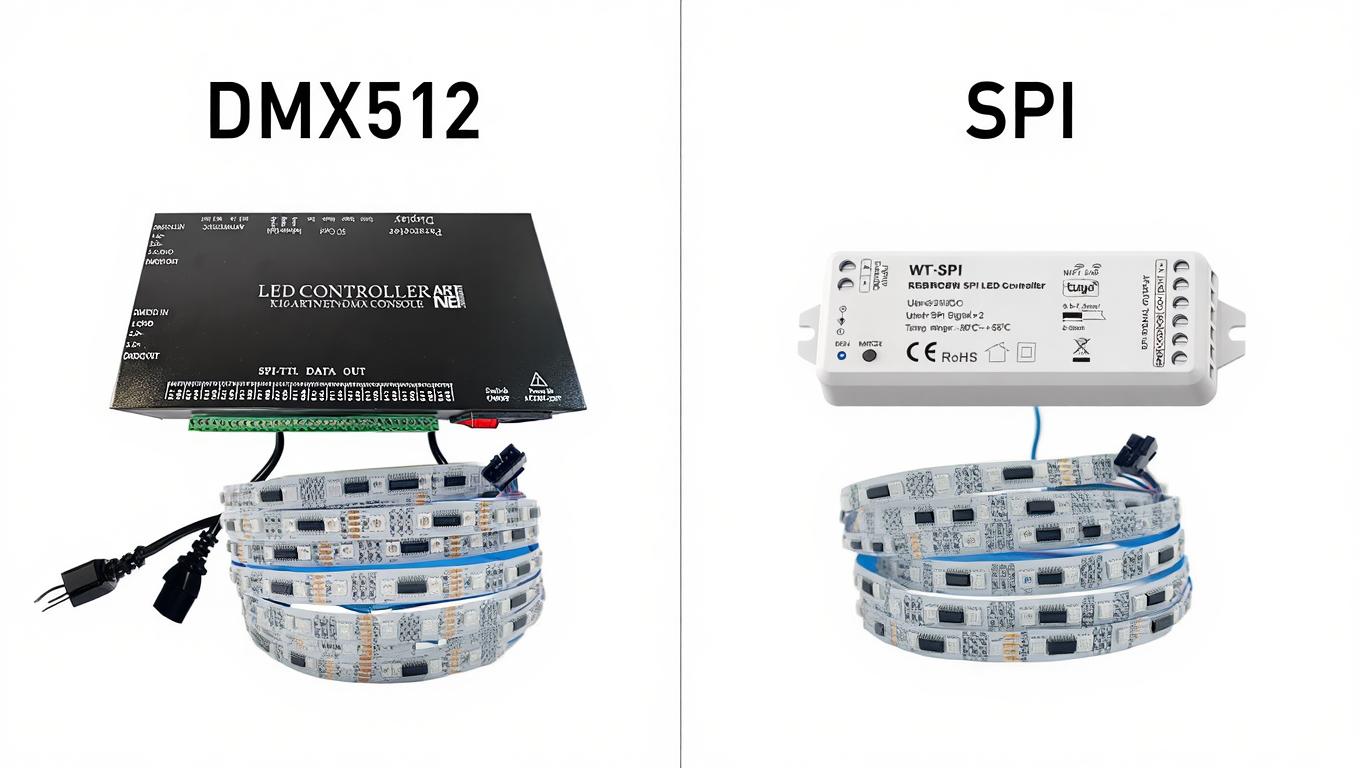
Choosing between DMX512 and SPI addressable LED strips can be confusing if you’re new to programmable lighting. Both offer stunning effects, flexible control, and high brightness—but they work in very different ways. Knowing how each system operates helps you pick the right one for your project, whether it’s stage lighting, architectural decor, or DIY installations.
In this guide, I’ll break down their technical differences, cost factors, performance, and installation needs. So you can confidently choose the best LED strip for your setup.
What is a DMX512 Addressable LED Strip?
DMX512 is a professional lighting control standard used in theaters, concerts, and stage events. “DMX” stands for Digital Multiplex, and “512” refers to the number of control channels per universe. Each channel can manage one function, like color or intensity.
DMX512 LED strips usually require a DMX decoder or controller, which receives commands from a lighting console. These strips are designed for long-distance communication and are ideal for synchronized effects across multiple fixtures. Common DMX LED ICs include UCS512, WS2821, and TM512.
If you’ve seen large-scale building facades or concert lighting synced with music, you’ve likely seen DMX512 in action. It’s reliable, precise, and highly scalable for complex lighting systems.
What is an SPI Addressable LED Strip?
SPI (Serial Peripheral Interface) is a simpler communication protocol used mostly for small to medium-sized projects. Each LED pixel has its own integrated control chip—popular types include WS2812B, SK6812, and APA102. These chips communicate via a data line controlled by a microcontroller, such as an Arduino or ESP32.
Unlike DMX, SPI doesn’t need external decoders. It’s faster, cheaper, and easier to set up. However, the control distance is limited—usually under 10 meters without signal amplification. That makes SPI strips a great choice for ambient lighting, DIY projects, gaming rooms, and short decorative runs.
DMX512 vs SPI — Core Technical Differences
Both systems control addressable LEDs, but they use very different communication and control methods. Here’s how they stack up.
Communication Protocol and Data Handling
- DMX512 uses a differential signal (RS-485), which allows reliable data transmission over long distances—up to 300 meters. It supports multiple universes for large installations.
- SPI uses single-ended serial data, limited to shorter distances. Signal degradation occurs beyond 5–10 meters without boosters.
Controller and Compatibility
DMX512 requires:
- DMX console or software (like Madrix or Lightjams)
- DMX decoder or controller
- Shielded 3-pin or 5-pin cables
SPI requires:
- Microcontroller (Arduino, ESP32, Raspberry Pi)
- Simple power supply
- Optional amplifiers for long runs
Pixel and Channel Management
In DMX512, each universe supports up to 512 channels. A single RGB pixel consumes 3 channels (R, G, B), so a DMX universe can control about 170 pixels. To handle more, multiple universes are required.
SPI strips can manage thousands of pixels using just one data line, depending on the controller’s processing power. This makes SPI more flexible for large LED walls or gradient effects without complex wiring.
Installation and Setup Requirements
When it comes to installation, DMX512 and SPI differ significantly in wiring, configuration, and setup time.
Wiring Complexity
DMX512 wiring is more robust. It uses shielded cables to prevent interference and terminators at each end of the line to maintain signal integrity. You’ll also need to daisy-chain the fixtures properly—controller → decoder → strip.
SPI wiring is simpler: data, power, and ground lines. However, voltage drop and signal degradation can occur on long runs, so you may need amplifiers or repeaters for large setups.
Software Configuration
DMX512 systems require addressing each fixture with unique IDs, usually through DIP switches or software. This process can be time-consuming for beginners.
SPI systems are plug-and-play with most DIY software. Tools like WLED, FastLED, and xLights make it easy to configure effects without professional-grade controllers.
Power Considerations
Both systems consume significant power depending on LED density. DMX512 installations often use external power supplies at multiple points to prevent voltage drop. SPI strips, especially those using WS2812B or SK6812, also need power injection every few meters for consistent brightness.
Always plan power distribution before installation to avoid overheating or color inconsistencies.
Performance Comparison — Brightness, Speed, and Control Precision
Performance is a major deciding factor when choosing between DMX512 and SPI systems. Let’s explore how they compare.
Brightness and Color Control
Brightness depends on the LED chip type, not just the protocol. Both DMX512 and SPI strips can achieve vivid colors and high brightness levels. However, SPI-based strips like SK6812 offer smoother transitions and higher refresh rates—ideal for gradient or rainbow effects.
DMX512 excels in precision and synchronization. When multiple fixtures must react simultaneously—like in concerts or large stage setups—DMX is the industry standard.
Refresh Rate and Latency
SPI has a faster refresh rate (up to 2–3 kHz), making it perfect for real-time animations. DMX512 operates at around 44 frames per second, which is sufficient for human eyes but slower than SPI for intricate effects.
That’s why gamers, YouTubers, and designers often prefer SPI LED strips for responsive ambient lighting synced to visuals.
Scalability and Stability
DMX512 wins when scalability and reliability are priorities. It supports thousands of fixtures across long distances without data loss. SPI, while faster, struggles beyond 10–15 meters without signal boosters.
In short:
- DMX512 = Long distance, professional stability
- SPI = Fast data, short distance flexibility
Cost and Maintenance Considerations
Budget often determines which system to choose. Here’s what you need to know about cost, durability, and maintenance.
Initial Cost and Components
DMX512 setups require more hardware—controllers, decoders, and cables—so initial costs are higher. They’re ideal for venues, clubs, and installations where reliability matters more than cost.
SPI systems need only a microcontroller and power supply, making them affordable for personal or small business use.
| Category | DMX512 System | SPI System |
| Controller Cost | $100–$500 | $10–$50 |
| Installation Complexity | High | Low |
| Maintenance | Moderate | Easy |
| Ideal Use | Stage, Commercial | Home, DIY |
Longevity and Maintenance Tips
Both LED types can last over 50,000 hours if properly managed. Keep power supplies well-ventilated, avoid overvoltage, and check connections periodically.
For DMX512, always terminate the data line to prevent flicker. For SPI, use capacitors and level shifters to maintain stable signal integrity—especially on long data lines.
Real-World Applications and Use Cases
Both DMX512 and SPI addressable LED strips shine in different environments. Choosing the right one depends on how and where you plan to use them.
Best Uses for DMX512 LED Strips
DMX512 strips are designed for professional-grade installations:
- Stage lighting and concerts where synchronization matters
- Architectural lighting for building facades
- Nightclubs, theaters, and outdoor displays
They excel in environments that demand reliability, long-distance control, and multi-fixture management.
Best Uses for SPI LED Strips
SPI LED strips are popular among DIY enthusiasts and creators.
- Home decor and gaming setups
- Retail displays and small-scale signage
- Car interior and underglow lighting
For instance, WS2812B or SK6812 strips can be easily programmed with Arduino or WLED software to create colorful, music-reactive lighting in your room or car.
Pros and Cons Summary
| Feature | DMX512 LED Strip | SPI LED Strip |
| Control Range | Up to 300m | Up to 10m |
| Installation | Complex | Simple |
| Cost | Higher | Lower |
| Speed | Moderate | Fast |
| Scalability | Excellent | Limited |
| Software | Professional (Madrix, Lightjams) | DIY (WLED, FastLED) |
| Ideal For | Stage, Events, Architecture | Home, DIY, Automotive |
Common Mistakes and How to Avoid Them
- Mixing protocols – DMX and SPI aren’t directly compatible. Using one controller for both requires signal conversion.
- Ignoring voltage drop – Always use adequate power injection points, especially with long LED runs.
- Underestimating control needs – For complex installations, DMX is essential. For quick personal projects, SPI saves time and money.
- Skipping waterproof ratings – For outdoor projects, choose IP65 or higher-rated strips.
Final Thoughts
DMX512 and SPI addressable LED strips both deliver powerful, customizable lighting effects—but their purposes differ. DMX512 is built for professional, large-scale installations demanding precision and distance. SPI, on the other hand, offers speed, affordability, and simplicity for personal or small commercial projects.
Before buying, assess your control needs, budget, and installation size. For long runs and synchronized shows, go DMX512. For fast effects and creative home or car lighting, go SPI. Explore our collection of DMX512 and SPI LED strips on our website today to find the perfect match for your next lighting project!
FAQs
Which is better, DMX512 or SPI LED strip?
DMX512 is best for large-scale professional projects needing long-distance, stable control. SPI is ideal for short, fast, and affordable installations like home decor or vehicles.
Can DMX512 and SPI systems work together?
Yes, but they require a DMX-to-SPI decoder or controller that supports both protocols. Without conversion, they can’t communicate directly due to different signal formats.
Is SPI faster than DMX512?
Yes. SPI offers higher refresh rates and lower latency, making it perfect for real-time animation or visual effects. DMX512 focuses more on synchronization and multi-fixture stability.
What are the wiring differences between DMX512 and SPI?
DMX512 uses shielded twisted-pair cables with 3 or 5 pins, while SPI uses simpler 3-wire or 4-wire setups (data, clock, power, ground). SPI wiring is easier but less distance-capable.
Which LED strip is easier to install?
SPI LED strips are easier to install and program, requiring only a microcontroller and power. DMX512 requires addressing, daisy-chaining, and professional-grade controllers.